Grown by Mother Nature ... crafted by Spirit of Old

  Home Shop Magick Order Contact us
  Home
  Shop
  Special offers
  Book of Shadows
  Tree properties
  Wheel of the Year:
  - Samhain
  - Yule
  - Imbolc
  - Eostre
  - Beltaine
  - Litha
  - Lammas
  - Mabon
  Moon and Sun
  Links
  Contact us


Lammas

Lammas is a Saxon name meaning "loaf mass". Falling on 1st August, this fire festival celebrates the corn harvest. The "loaf" is the first loaf baked with the newly harvested corn.

It is also commonly known by the Celtic name of "Lughnasadh" which means "games of Lugh". Lugh was a God of light, a Sun king. Lugh's games were celebrated with contests, fairs and rivalry. Livestock fairs were held and goods were traded. In some parts of the country, Lammas fairs were held where servants and farm workers would contract with Master or Mistress for a year and a day - from August 1st to August 1st the following year when they were free to seek a new Master or Mistress.

Lammas is a festival of rejoicing in the harvest, yet it is also a reminder that death is ever-present because the strength of the Sun is now ebbing away with the approach of the Winter once again. People were also reminded of death during the harvesting - as the reapers cut their circular swathe from the outside edge of the fields to the inner foxes, rabbits and other small animals were trapped at the centre. Eventually they would break their cover and attempt to flee but they usually ended up as meat for the pot.

Lammas was also a time when peace returned to the land. Summer was the time for war but no-one could sustain a Winter campaign for long so war was halted at Lammas when the men were needed to gather the wheat.

Barley is also harvested at Lammas and is used to brew ale. This is celebrated in the traditional song "John Barleycorn".

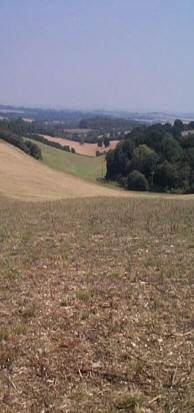
Lammas fields

The Ballad of John Barleycorn

There was three men came out of the West
Their fortunes for to try,
And these three men made a solemn vow:
John Barleycorn must die.
They ploughed, they sowed, they harrowed him in
Throwing clods all on his head,
And these three men made a solemn vow:
John Barleycorn was dead.

They've left him in the ground for a very long time
'Til the rains from heaven did fall,
Then little Sir John's sprung up his head
And so amazed them all.
They've left him in the ground 'til the Midsummer
'Til he's grown both pale and wan,
Then little Sir John's grown a long, long beard
And so become a man.

They hired men with their scythes so sharp
To cut him off at the knee,
They've bound him and tied him around the waist
Serving him most barb'rously.
They hired men with their sharp pitch-forks
To prick him to the heart,
But the drover he served him worse than that
For he's bound him to the cart.

They've rolled him around and around the field
'Til they came unto a barn,
And there they made a solemn mow
Of Little Sir John Barleycorn.
They've hired men with their crab-tree sticks
To strip him skin from bone,
But the miller, he's served him worse than that
For he's ground him between two stones.


Here's little Sir John in the nut-brown bowl
And brandy in the glass,
But little Sir John in the nut-brown bowl's
Proved the stronger man at last.
For the huntsman, he can't hunt the fox
Nor so loudly blow his horn,
And the tinker, he can't mend kettles or pots
Without a little of Sir John Barleycorn.

Traditional


Google
 

Page last updated: 22 March, 2008

All images and text (unless stated otherwise) © Spirit of Old. Click here for further info.
Page copy protected against web site content infringement by Copyscape

www.spiritofold.co.uk